
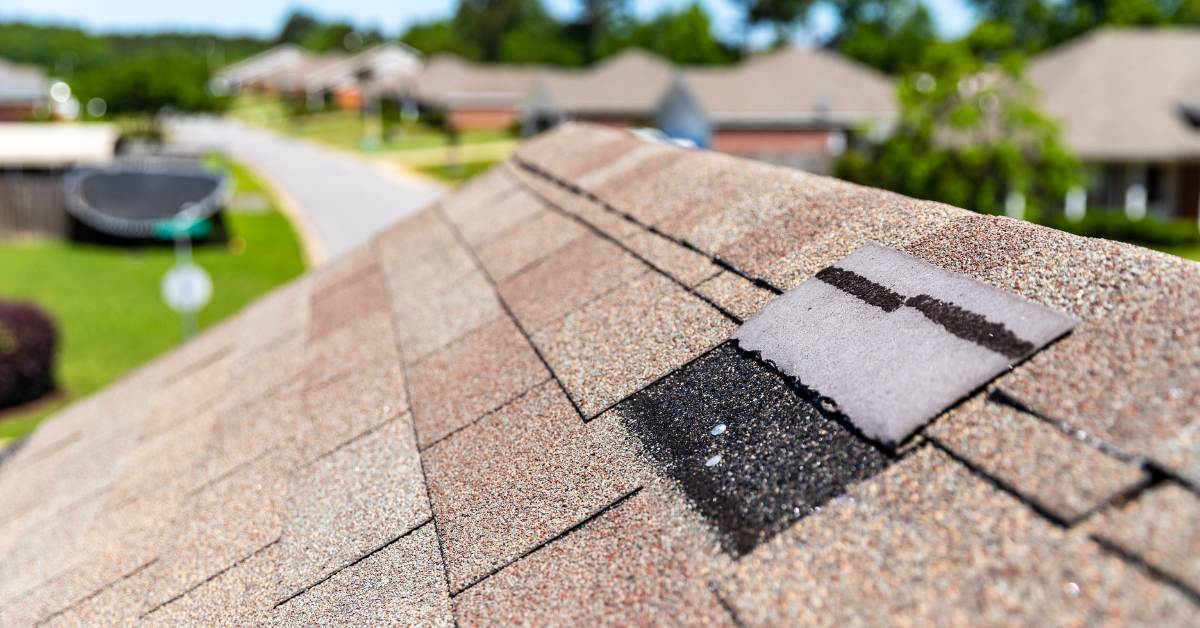
It depends on four things you can assess from the ground: how many shingles are gone, where on the roof they were, what is visible underneath the gap, and what the weather is doing next. A couple of missing shingles in the middle of a slope, with intact underlayment showing and a dry stretch in the forecast, is a repair you schedule. A gap near a valley, an edge, a ridge or a penetration, or any gap showing bare wood decking, with rain coming, is a call you make today. What is never the answer is going up to look, or going up to fix it.
Here is how to tell the difference without leaving the yard.
What is actually exposed when a shingle leaves
A shingle is not the only thing between your ceiling and the sky. Under it sits underlayment, which is a layer of felt or synthetic sheet material laid over the roof deck, and under that sits the decking itself, usually plywood or oriented strand board.
That layering is why a missing shingle is not automatically a leak. Underlayment is a genuine water barrier, and an intact section of it can shed rain for a while. It is not designed to do that job indefinitely or without the shingles above it, and it degrades quickly once it is exposed to sun, wind and standing water. But in the short term, it buys time.
So the first question is not “is a shingle missing”, it is “what can I see through the gap”. From the ground with binoculars, a gap showing a dark, flat, continuous surface is probably underlayment. A gap showing lighter, grainier, wood-colored material, or showing nail heads and seams, is likely bare decking. Bare decking is a different level of urgency, because there is now nothing between rain and the structural surface of your roof.
If you have not done a ground survey before, the method is set out in how to check your roof for hail damage without climbing it, and the same discipline applies here.
The four things that decide urgency
How many, and are they together. One or two isolated shingles is a different situation from a run of eight along a course. A continuous run means the wind found a seam and worked along it, and it is more likely to keep going in the next gust.
Where on the roof. The middle of a large slope is the most forgiving place to lose a shingle, because water there is still traveling across a broadly intact surface. Valleys, edges, ridges, and the areas around chimneys, skylights, vents and pipe boots are the least forgiving, because those are the places where roofs concentrate water and depend on layered detailing rather than on the shingle alone. A gap near any of them is more urgent than its size suggests.
What is underneath. Intact underlayment buys days. Bare decking buys almost nothing.
What the sky is doing. A dry week changes the answer more than anything else on this list. A line of storms tonight collapses the timeline regardless of how small the gap looks.
Lifted shingles are the finding people miss
The shingles that blew off are the obvious damage. The more consequential finding is usually the ones that are still there.
Asphalt shingles are held down partly by nails and partly by a strip of adhesive that bonds each shingle to the one below it once the sun warms it. Wind can break that seal without moving the shingle far enough for anyone to notice from the driveway. A shingle whose seal has broken is, functionally, no longer attached. It will lift in the next moderate wind, it can drive water backwards underneath itself, and it is a failure that a ground survey will rarely catch.
This is one of the honest limits of looking from the ground, and it is why a roof that lost three shingles frequently turns out to have a much larger area of compromised sealing around them. A professional inspection finds that. Binoculars generally do not.
Tonight, this week, or the next appointment
Today or tonight if bare decking is visible, if the gap is at or near a valley, edge, ridge or penetration, if the affected run is large, or if rain is in the forecast before you can get anyone out. In that situation the next step is a professionally installed temporary cover, which is a job with its own rules and its own hazards, covered in emergency tarping: what it costs and who should do it.
This week if the gap is mid-slope, underlayment is intact, the area is small, and the forecast is dry. Book a licensed roofer for an inspection and repair, and use the time to document properly.
Next available appointment if you found nothing missing but suspect the storm was significant. That is still worth an inspection, because of the sealing problem described above.
In every one of those cases the person going onto the roof is a licensed roofing contractor. There is no version of this where the sensible move is a homeowner on a ladder after a storm.
What not to do while you wait
Do not climb up to look. A roof after a windstorm is wet, it may have loosened decking or fasteners you cannot see, and the debris that came off it is now on the surface you would be standing on. Roofing is consistently among the most dangerous work done on residential property, and it is dangerous for people who do it professionally with equipment and training.
Do not clear debris off the roof, and do not let anyone else do it before the damage has been documented. Removing evidence before it is photographed can undercut your own claim.
Do not make permanent repairs before an adjuster has seen the damage. The Texas Department of Insurance says this directly in its storm recovery guidance: make temporary repairs to prevent more damage, keep a list of repairs and save receipts, and do not make permanent repairs before the adjuster has been out.
Do not accept an offer from someone who turns up unannounced to “just take a quick look” at no charge. That is a sales call, and the pattern it follows is set out in storm chaser roofers in Texas: red flags to watch.
When this becomes an insurance claim rather than a repair
A handful of missing shingles on an otherwise healthy roof is often a repair that costs less than a windstorm and hail deductible, particularly in Texas where that deductible is frequently expressed as a percentage of the dwelling coverage rather than as a flat amount. Filing in that situation can cost you more than it returns.
Missing shingles as part of broader storm damage across the property is a different matter, and so is a roof where the wind has compromised sealing across a large area. That is a claim question rather than a repair question, and it is worked through in should you file a roof insurance claim in Texas. If the same storm also brought hail, the two perils interact in ways worth understanding, which is covered in wind damage and hail damage are not the same claim.
And if the storm has only just passed and you are working out what to do first, the sequence is in Hail Just Hit Your Roof: What to Do in the First 72 Hours.
The reason this site publishes the “you probably do not need to do anything tonight” version of the answer at all is explained on the about page and in why RoofGuidance will not write about most roofing topics.
FAQ
How long can a roof go with a missing shingle?
There is no fixed answer, because it depends on what is exposed and on the weather. Intact underlayment can shed water for a while but degrades once exposed. Bare decking should not be left uncovered through a rain event. Treat it as a matter of days in dry weather and hours if rain is coming.
Can I just put a new shingle on myself?
No. Doing that means being on a roof, which is the one thing this site does not tell readers to do, and a shingle installed without correctly re-integrating it with the courses above and below it can create a leak path rather than closing one.
I found the shingle in my yard. Is it useful?
Yes. Keep it. It shows the product, and how it failed at the nail line or the seal line is information an inspector can use. Photograph it where it landed before you move it.
The wind rating on my shingles says they should survive this. Does that mean the installation was bad?
Not necessarily. Manufacturer wind ratings are established under controlled test conditions on correctly installed, fully sealed product, and real roofs vary in age, sealing, exposure and installation detail. If you want to know your own product’s rating, it is on the manufacturer’s data sheet for that specific shingle line rather than in any general figure quoted online.