
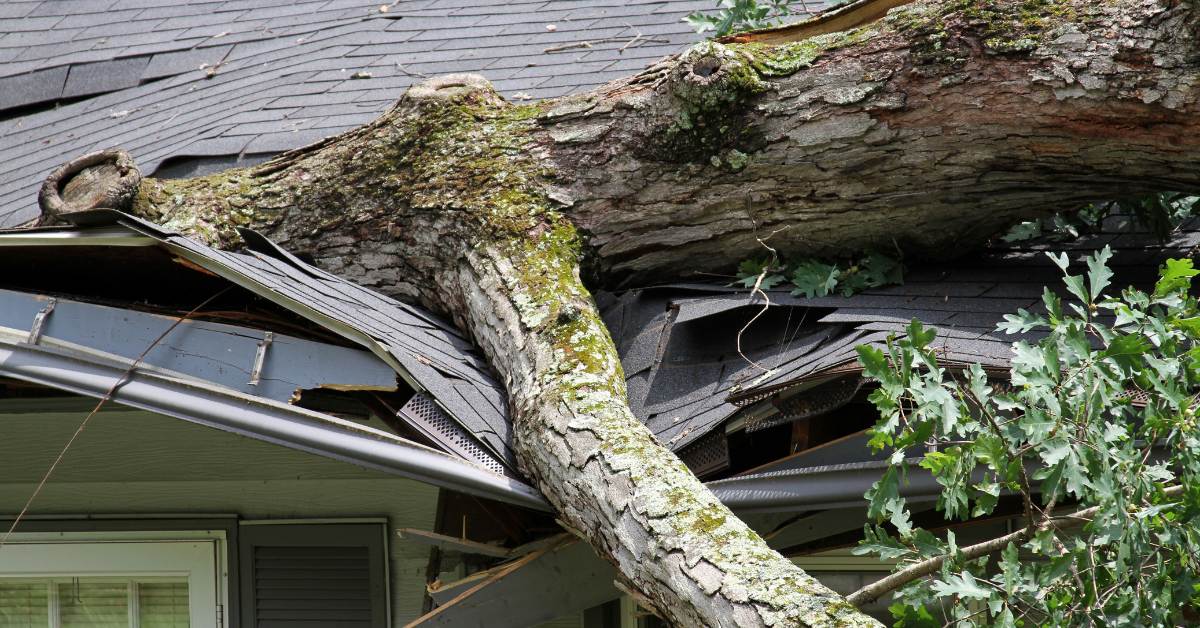
You do not choose which peril to report. You report the damage you can see and the date it happened, and the insurance company decides what caused it. On most standard Texas homeowners policies, wind and hail are covered together under a single windstorm and hail provision with one shared deductible, so the label usually does not change what you pay out of pocket. Where the label does matter is in the evidence: wind damage and hail damage look different, fail differently, and are argued differently, and some policies carry an endorsement that treats cosmetic hail marks differently from wind losses. The distinction is worth understanding even though it is not yours to make.
Here is what actually separates the two, and where the difference has teeth.
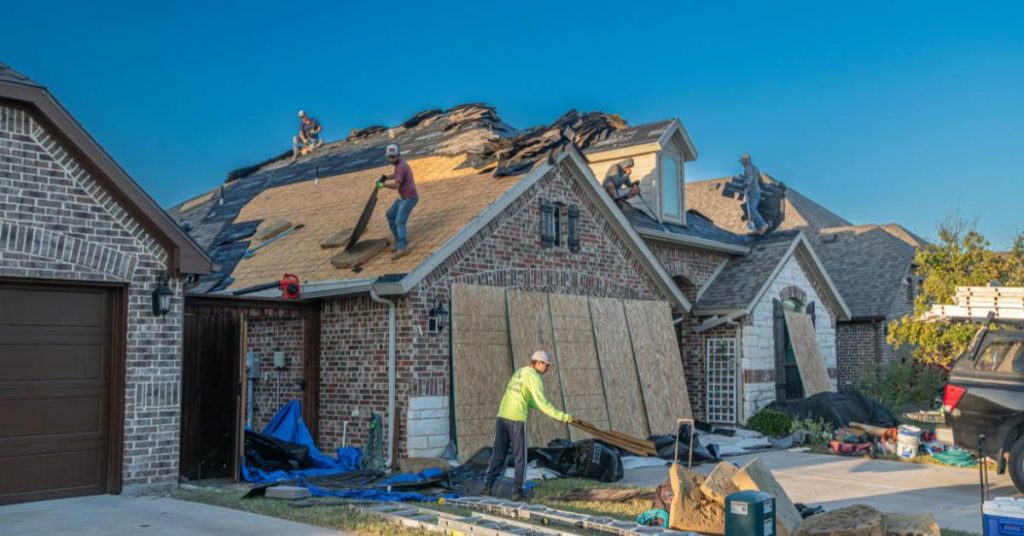
What each one does to a roof, and why that matters as evidence
Hail arrives from above and lands more or less at random across the whole roof plane. Its signature is impact: bruised spots where the mat under the surface has fractured, cracks, granule loss concentrated in circular marks, and dents in soft metals like vents, flashing, gutters and the fins on an air conditioning condenser. Hail damage is distributed. If it is real, it should be findable on more than one slope, and it should be corroborated by damage to things that are not the roof.
Wind works differently. Wind gets under an edge and peels. Its signature is directional and it clusters at the places where a roof presents an edge to the airflow: rakes, eaves, ridges, hips, and anywhere a previous repair or a poor seal gave it something to grab. Wind damage tends to concentrate on the windward slopes and to leave the leeward side largely alone. Shingles go missing, crease across the middle where they folded back and slapped down again, or break their factory seal without visibly moving.
That asymmetry is the point. A roof with uniform impact marks across every slope tells one story. A roof with a torn strip along one rake edge and nothing anywhere else tells a different one. An adjuster reads the pattern, not just the damage, and so does a competent independent inspector. If you want to understand what “counts” once someone is up there, the counting method itself is covered in the test square: the rule adjusters use, explained.
You do not pick the peril. You report the damage.
This is the single most common mistake in the way homeowners approach a mixed storm, and it comes from a reasonable instinct: people assume that naming the cause correctly is part of filing correctly, and that naming it wrong will hurt them.
It is not your job. Report the date, report what you have observed, and let the carrier assign causation. Guessing at a peril and then trying to make your description fit it is worse than useless, because if the assigned adjuster reads the roof differently you have now built your account of events on a foundation you did not need. Describe what you saw and what you found. That is the whole obligation.
The corollary is that you should report everything from the event, not just the roof. A storm that stripped shingles very likely also marked the gutters, the screens, the fence, the outdoor unit and the garage door. Those things belong in the same claim and they are also, incidentally, the evidence that supports the roof.
Where the label genuinely bites
There are three places where wind versus hail stops being academic.
Cosmetic damage exclusions. Some policies carry an endorsement that excludes damage which is purely cosmetic, meaning it changes the appearance of a roof surface without affecting its ability to shed water. In practice these endorsements are usually written around hail, because hail is the peril that most often produces marks that look bad and do nothing. A missing shingle is not cosmetic under any reading. A dented metal panel might be. If your policy carries one of these endorsements, the functional versus cosmetic question becomes the whole claim, and that distinction is worked through in full in functional vs cosmetic hail damage.
Date of loss. Wind and hail often arrive in the same storm, but not always, and a roof can carry damage from two different events months apart. Which peril is being claimed drives which date is attached to the claim, and the date drives everything downstream.
Consistency. If a claim is submitted describing hail and the roof shows a directional wind pattern with no impact evidence anywhere, that inconsistency becomes the conversation. Not because anyone is accusing you of anything, but because causation is what the carrier is actually evaluating.
The deductible question, and why it usually is not the deciding factor
Homeowners often assume that getting the peril labeled one way or the other will change the deductible. On most standard Texas homeowners forms it will not, because wind and hail are bundled into a single windstorm and hail deductible that applies to both.
What surprises people is not which peril applies, it is the shape of that deductible. Many Texas policies express the windstorm and hail deductible as a percentage of the dwelling coverage amount rather than as a flat dollar figure, which means it scales with the insured value of the house and can be several times larger than the all-other-perils deductible printed on the same page. That number is on your declarations page. It is not something anyone online can tell you, and any article that quotes a percentage as though it were standard is guessing at your policy.
Read the declarations page before you do anything else, and read it looking specifically for a separately stated windstorm and hail deductible. If the arithmetic between that number and the likely cost of repair is what you are really trying to resolve, that is a different decision and it is walked through in should you file a roof insurance claim in Texas.
The coastal exception most Texas advice skips
Almost every article about Texas roof claims is written as though Texas had one insurance market. It does not, and the split matters enough to state.
In a group of Gulf Coast counties and part of Harris County, windstorm coverage is frequently not part of the standard homeowners policy at all. It is written separately through the Texas Windstorm Insurance Association, which exists precisely because the private market has historically been unwilling to carry coastal wind risk. A homeowner in that territory can be holding two policies with two deductibles, and for them the wind versus hail question is not a labeling exercise, it is a question of which insurer they are even talking to.
If you are in Dallas, Fort Worth, Plano, Frisco or anywhere else in North Texas, this almost certainly does not apply to you and your wind and hail coverage sits inside your homeowners policy. If you are on the coast, verify which policy covers wind before you report anything. The Texas Department of Insurance publishes the current TWIA territory and can confirm it.
What to do if one storm plainly did both
Nothing changes procedurally. Report the event once, with one date, describing everything you found. If the carrier’s inspection concludes that some of the damage is wind and some is hail, that is an internal determination that generally resolves into one claim against one deductible on a standard homeowners policy.
What you should do is make sure the record you hand over contains both kinds of evidence, because they support each other. Impact marks on the gutters and the condenser fins corroborate hail. A creased or missing run along one edge corroborates wind. A storm that produced both left both, and a homeowner who documented only the missing shingles has quietly thrown away half of their own case.
Before anyone comes to look, walk the ground and check what is reachable, which is more informative than most people expect. That process is covered step by step in how to check your roof for hail damage without climbing it. If shingles are actually gone and you are trying to work out whether that is a tonight problem, start with missing shingles after a windstorm.
And for the order of operations in the hours right after the storm, before any of this, the full sequence is in Hail Just Hit Your Roof: What to Do in the First 72 Hours.
Why this site explains the process rather than steering you toward a particular outcome is set out on the about page and in how we decide what gets recommended on this site.
This article describes how claims are generally structured. It is not legal advice and it is not a prediction about your claim. Decisions with legal consequence belong with a licensed public adjuster or an attorney.
FAQ
Should I file one claim or two if the storm caused both wind and hail damage?
One event, one claim, one date of loss. The carrier sorts the causation internally. Filing twice for a single storm creates confusion rather than coverage.
Does it cost me more if the damage is called hail instead of wind?
On a standard Texas homeowners policy, usually not, because both perils fall under the same windstorm and hail deductible. The exception is a policy carrying a cosmetic damage endorsement, where the classification can affect whether certain marks are covered at all. Check your declarations page and your endorsements.
My roof is missing shingles on one side only. Is that wind?
A directional, edge-concentrated pattern is consistent with wind, but consistency is not a determination and a single slope can also be the only one a hail core actually hit. Document what you see rather than labeling it.
Can an adjuster deny hail damage but accept wind damage on the same roof?
Yes. Perils are evaluated separately even when they arrive in the same storm, and a partial outcome is a normal result rather than an error. If a partial outcome does not match what you documented, that is the point to ask for the written findings and consider an independent opinion.